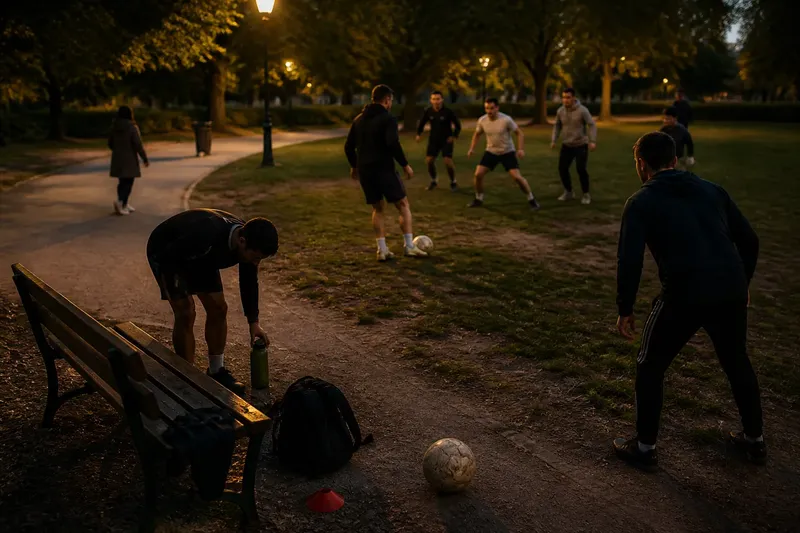
Why a Wall Can Be Part of the Goal
Wall goals make street football fit tight spaces. Compare rebound, touch-only and wall-as-frame rules, then choose a target everyone can judge clearly.
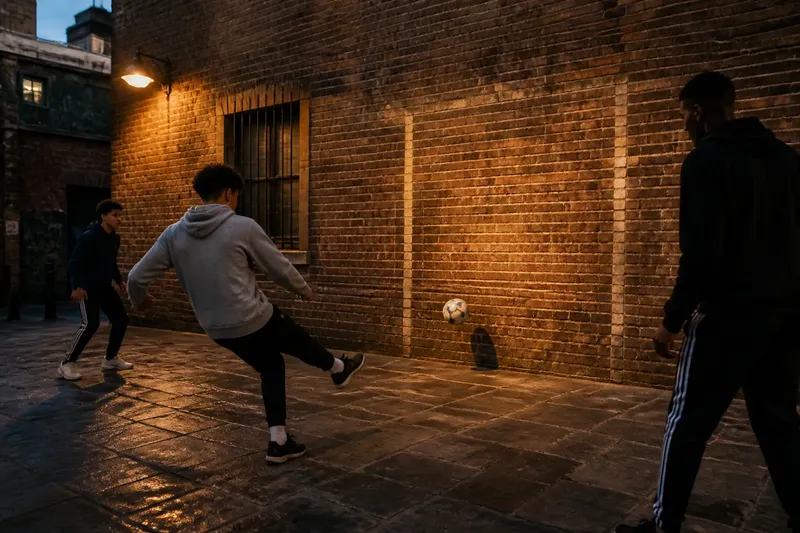
A ball skips off a curb, strikes brick, and rolls back into the game. In street football, a wall can be a goal, a passing partner, or simply a boundary. Wall-goal rules work best when players choose one clear use for the surface before the first kick.
The main options are rebound play, touch-only scoring, and a wall-as-frame target. Each changes what happens after contact. Choose according to the wall, the space around it, and how easily everyone can judge a shot.
Rebound rules keep the wall in play
Under a rebound rule, players can pass or shoot against the wall and play the returning ball. Decide whether a wall hit can also score or only keeps possession live; those are separate rules, not details players can safely guess.
A rebound can help in a narrow alley or a small paved court where long passes are difficult. It gives a player another route when a direct path is blocked, but it also sends the ball back into the playing area. Consider nearby pedestrians, doorways, windows, and parked objects before using a wall this way.
Set the playable surface using features everyone can see, such as a brick seam or the space between two solid pillars. Exclude windows, doors, loose objects, and any section obscured from one side. Use a solid, clear surface, and do not attach chalk or tape to public property without permission.
Say you are playing in a narrow paved lane and want wall passes but not wall goals. Agree that any hit within the chosen brick section keeps the ball live, while scoring still requires the ball to cross a separate target boundary. The result is a rebound option without confusion over whether a pass earned a point.
Touch-only rules make scoring calls quick
With touch-only scoring, the ball scores when it strikes an agreed part of the wall, and play stops for a restart. The wall marks the goal rather than acting as a teammate. This can suit a casual game without a net, especially where a hard rebound could send the ball toward other people or objects.
Define the target using a visible seam, doorway edge, or other fixed feature. Agree on its height and width, and make sure players can see the boundaries from both directions. Exclude fragile or occupied sections rather than relying on players to avoid them during a shot.
Settle whether the ball must hit the target directly or may touch the ground first. A direct-shot rule is easy to state; allowing a bounce is also possible, provided both sides use the same rule. For a ball that hits outside the target, agree whether play continues or the other side restarts.
Wall-as-frame rules reward a precise target
A wall-as-frame rule treats a defined section like a goal opening. The ball must strike within the agreed area to score; contact elsewhere does not. A gap between pillars or a section bounded by clear brick joints can provide a target without portable equipment.
Before play, decide whether the ball must strike the wall directly, whether a ground bounce is allowed, and how to judge contact on the edge. One simple boundary is that any contact inside the chosen section scores and contact outside it does not. If the edge is hard to see from either side, choose a broader target or a different rule.
Compared with rebound play, a wall-as-frame target emphasizes aiming rather than using the surface to pass. Compared with touch-only scoring, it makes the target area itself central to the call. The wall’s shape and the people sharing the space should determine which tradeoff makes sense.
Wall-goal rules answer these common questions?
Does every wall hit count as a goal?
No. A hit counts only if players agree that the wall is a scoring target and define the area that counts. Otherwise, the hit can keep the ball live under a rebound rule or have no special effect.
Can a wall rebound be used as a pass?
Yes, if the group has chosen a rebound rule and the selected surface is clear and safe for play. Agree which part of the wall is in bounds so a hit on a doorway or window does not create a dispute.
What should players do about a close call?
Point to the agreed boundary and make a quick shared call before restarting. If close calls keep happening, simplify the target or use a larger, more visible section.
Which wall rule suits a crowded space?
Touch-only scoring may limit repeated rebounds, but it still requires a safe target and a clear area around it. If a ball could reach pedestrians or vulnerable property, choose another playing surface or stop using the wall.
Check the wall and agree on the rule
Before play, inspect the surface and nearby space, then state the target, contact rule, and restart. Use this short check to make a clear decision:
- Check whether the selected surface is solid and free of loose objects; if it is, agree on its usable section, and if it is not, choose another wall or play without wall contact.
- Check whether windows, doors, or other vulnerable features lie in the ball’s path; if they do, exclude that section or move the game, and if they do not, identify the safe target area.
- Check whether players can see the target boundary from both directions; if they can, use it as marked by existing features, and if they cannot, pick a broader or more visible target.
- Check whether a direct wall hit should score; if the group wants wall goals, define the scoring area and restart, and if not, state that contact only keeps play live or has no effect.
- Check whether a ball may bounce before hitting the target; if the group wants to allow it, say so before play, and if not, require direct contact and apply that rule to both sides.
- Check where the ball goes after it rebounds; if it could reach pedestrians or parked objects, use touch-only scoring or choose another surface, and if the area is clear, agree which rebound contacts remain in play.
- Check what happens when the ball hits outside the target or leaves the playing area; if the group agrees on a restart, name who takes it, and if the boundary remains unclear, simplify the rule before starting.
Imagine three players arrive at a paved courtyard with a brick wall, a window near its left side, and a clear section between two visible seams. They first exclude the window, then agree that only the clear section is a target and that the ball must hit it directly; ground bounces do not count. They decide that an in-bounds hit scores and stops play, while contact outside the section leaves the ball live only if it returns to the courtyard. The resulting rule is a touch-only wall goal, with the tradeoff that rebounds are not used for passing.
Keep the agreement short enough for every player to repeat: which section counts, what contact means, and how play restarts. If the space or group changes, pause and make a new decision rather than letting the wall’s role drift from shot to shot. A clearly chosen wall-goal rule makes the target usable while leaving the shared space legible to everyone nearby.