The Myth That Every Kickabout Needs a Captain
A kickabout without a captain can share its practical work: rotate setup tasks, tend the space and keep neighborhood play welcoming for everyone.
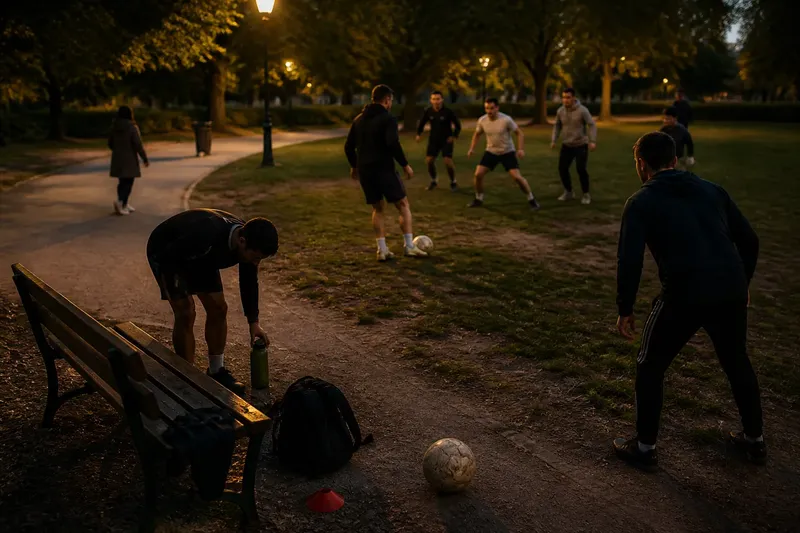
A ball rests beside a park bench while one player moves a water bottle out of the way and another checks that the path stays clear. A kickabout without a captain can still run smoothly when people share the work that keeps the game and its surroundings in good shape.
A kickabout without a captain needs shared upkeep
Informal football depends on more than the players on the ball. Someone has to notice a pedestrian approaching, retrieve a stray ball, keep bags clear of the playing area and check that the group is not spreading into a space others need.
Those jobs are easy to overlook when one regular quietly handles them every time. Spread them around instead. A shared routine makes the game less dependent on one person and helps everyone recognize that a public space has other users.
Keep the arrangement informal: name the task, invite someone to take it, and pass it to another player next time.
Share the small jobs around the playing space
Before play begins, identify the tasks that actually matter in that spot. A paved court beside a walkway has different needs from a grassy park corner. Avoid creating duties for their own sake; focus on keeping equipment contained, pathways open and the space ready for the next group.
- Bags and coats: Check whether they sit outside the play area and away from a path; if they do, leave them there, and if not, move them together to a spot players can still see.
- Water bottles: Check whether bottles are near the ball’s route; if they are, place them with the bags, and if they are already clear of play, leave them in place.
- Loose equipment: Check whether cones or spare balls could roll into a walkway; if they could, gather them at the edge, and if the space is already clear, keep the setup as it is.
- Public access: Check whether the playing area blocks a path, entrance or bench; if it does, shift the game to an open patch, and if no route is obstructed, keep the boundary visible.
- Stray balls: Check whether a ball has rolled toward people or traffic; if it has, stop play and retrieve it safely, and if it remains within the playing area, continue.
- End-of-game cleanup: Check whether any personal item or piece of equipment remains behind; if something is left, return it to its owner or collect it, and if the area is clear, leave it ready for others.
Make the task visible, then get back to the game.
Fit play around the people who share the site
Public spaces are not private pitches. Walkers may cross a park, families may use a nearby bench, and other players may be waiting for the paved area. A group can adapt its shape without treating those neighbors as obstacles.
Choose a boundary that leaves a clear route through the space. If a path runs beside the game, keep the ball away from it where possible and pause when someone needs to pass. If the area becomes crowded, shift the playing zone or take a break rather than asking others to work around the match.
Say you are playing on a small patch of grass beside a park path. A walker needs to pass through the space your group has been using, so you move the two bags behind a bench, bring the nearer boundary inward, and resume only after the route is open. The expected result is a smaller playing area with a usable path, not a forced choice between the game and access.
What does shared upkeep look like in practice?
Who should collect a ball that leaves the playing area?
The nearest player can retrieve it if doing so is safe and does not require crossing traffic or interrupting someone else’s activity. If retrieval would be unsafe or disruptive, stop play and wait for a clear opportunity.
Where should players put bags and coats?
Keep them together at the edge of the playing area, away from walkways and entrances. If no clear spot is available, reduce the playing area or choose another place rather than scattering belongings across public space.
How can a group respond when a path gets busy?
Pause and leave the route open while people pass. If foot traffic continues through the playing zone, move the boundary or find a less disruptive area.
What should players do before they leave?
Look over the spot for bottles, bags, cones and balls, then return each item to its owner or collect it. If the space is clear, leave it as you found it; if something belongs to another group, hand it back rather than packing it away.
Make shared tasks easy to pass along
Use a simple handoff instead of a formal roster. The person who brings cones can ask another player to gather them after the game; someone who has been watching the path can switch with a teammate next round. Naming the task and its next owner is clearer than assuming somebody will notice.
Imagine a group that has left a spare ball beside the entrance to a small court. One player notices the obstruction, asks another to move the ball to the equipment pile, and checks that the entrance is clear before play resumes. The observable result is an open entrance and a ball kept with the rest of the gear.
Shared upkeep does not need a permanent organizer. A kickabout without a captain works better when players notice what the space needs, take a small task, and make room for the people who use it too.