Before the Painted Lines: A Short History of the Urban Football Court
Urban football court history explains how informal games gained designated places, and how to trace a court’s local story through records and physical clues.

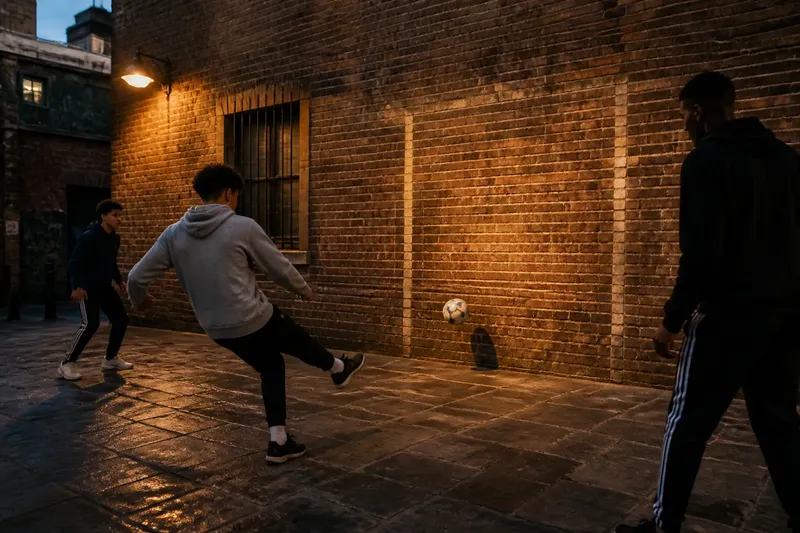
A ball skims over uneven pavement as two players use a curb for one goal and a backpack for the other. Urban football court history starts in scenes like this, but a specific court’s past cannot be established from its paint alone. To tell that story clearly, trace the site through dated records, changes to its layout, and the memories of people who used it.
Urban football court history depends on local evidence
There is no single documented sequence that describes how every city moved from street games to public courts. Streets, schoolyards, vacant lots, parks, and purpose-built facilities have coexisted, and their histories differ by place. A reliable account begins with a named site and evidence tied to it, rather than a broad claim that all cities followed the same path.
Useful sources include city park maps, recreation department records, planning documents, dated photographs, local newspapers, and oral histories. Each has limits. A map can show when a court appears in a public plan, but not necessarily when people first played there. A photograph may establish that goals or painted lines existed by a certain date, while leaving the reason for their installation unknown.
Start with the court’s exact name or street location. Search the municipality’s park and recreation pages, public library catalog, local newspaper archive, and planning-board minutes. Record the document title and date for each finding; if sources conflict, keep both accounts visible until another source clarifies the disagreement.
Borrowed spaces came before many formal courts
Football does not require a purpose-built surface. Players can adapt a quiet street, schoolyard, open lot, or park edge by choosing improvised goals and boundaries. Such spaces make play possible, but their availability depends on other uses: traffic returns to the street, a school closes its yard, a lot changes hands, or a park area is needed for another activity.
Those conditions help explain why a designated court can matter, but they do not prove that a particular court replaced a particular street game. To make that link, look for local evidence: a recreation proposal that names neighborhood play, a newspaper account of a new facility, or a resident’s dated recollection supported by records. Without such evidence, describe the broader pattern as context, not as the court’s documented origin.
Markings made a planned playing area legible
A marked surface, fixed goals, or fencing can signal that a site is intended for recurring football. These features also make a facility easier to distinguish from an open patch where games happen by custom. Yet a line or goal does not reveal when the court was built, who requested it, or how access rules changed. Those questions need records or testimony.
Compare evidence from different periods. A park plan might show a proposed court; a later photograph could confirm that goals were installed; maintenance records might document resurfacing. Treat each item as evidence for one claim only. A resurfacing record supports a maintenance date, for example, not a claim about the court’s original construction.
What can establish a court’s local history?
How can I find when a public football court opened?
Search city recreation records, park plans, local newspapers, and council or planning minutes for the court’s name and location. If those records establish only a planning date, report that the project was proposed then rather than claiming that the court opened then.
Can painted lines date a court?
Lines show that a playing area was marked at some point, but they rarely establish when the surface was first built. A dated photograph or maintenance record can narrow the timeline; describe the line itself as an undated physical clue unless a source confirms more.
How should oral histories be used?
Ask former players, neighbors, or recreation staff about specific details, such as where goals stood or when access changed. Record who supplied each recollection and when, then compare it with dated documents rather than presenting memory as an independently verified date.
What if sources disagree about a court’s past?
Separate what each source actually says and note its date and perspective. If the discrepancy remains unresolved, state that the accounts differ instead of choosing the more convenient version.
Build a timeline from claims you can support
Say you are researching a fictional court called Maple Yard. Your starting inputs are a current park map, a dated newspaper clipping, a planning document, and an interview with a former neighbor. The map labels a small football area but gives no construction date; the clipping reports that the city approved a proposal; the planning document describes intended work; the neighbor remembers playing there after the goals appeared.
First, enter each item in a timeline with its date, source, and exact claim. Next, distinguish approval from construction: the clipping supports the approval date, while the planning document supports what was proposed. Then compare the neighbor’s recollection with the dated materials. If no source confirms the installation or opening date, leave that date unknown. The resulting account can say the court was proposed on the documented date and was in use by the time described in the recollection, while clearly identifying the latter as oral testimony. That is a useful history without turning uncertain evidence into fact.
Check the site and choose what to say
- Check whether the city map names the court; if it does, use that official name, but if it does not, search by street or park name instead.
- Check whether a dated plan marks the playing area; if it does, describe it as planned on that date, but if it does not, do not infer a planning date from current markings.
- Check whether a newspaper report describes approval or completed work; if it reports approval, call the project approved, but if it documents completed work, cite that narrower claim.
- Check whether photographs carry reliable dates; if they do, use them to establish what was visible by then, but if they do not, treat them as undated visual evidence.
- Check whether maintenance records mention resurfacing or new goals; if they do, describe that documented change, but if they do not, avoid dating the court from its present materials.
- Check whether a resident’s recollection is corroborated; if it is, connect it to the supporting record, but if it is not, identify it as personal memory.
- Check whether two sources give different dates; if they do, present the conflict and explain what each date refers to, but if they agree on the same event, state that event with its source.
Keep a separate note for every claim you plan to publish. That simple habit makes it easier to distinguish a court’s documented timeline from the wider history of informal play.
A court’s past is more than its original plan
Construction records can explain why a court was designated, while photographs, maintenance documents, and oral histories can reveal how its form and use changed. A gate may appear in one image but not another; a later plan may show a changed layout. Each clue adds context, but the account should stay within what the evidence supports.
Urban football court history is most useful when it keeps the local record distinct from the general story of city play. Find the site’s name, assemble dated sources, and label recollections honestly; the result can show not only when a court entered a plan, but what remains known—and unknown—about how people made it part of neighborhood life.