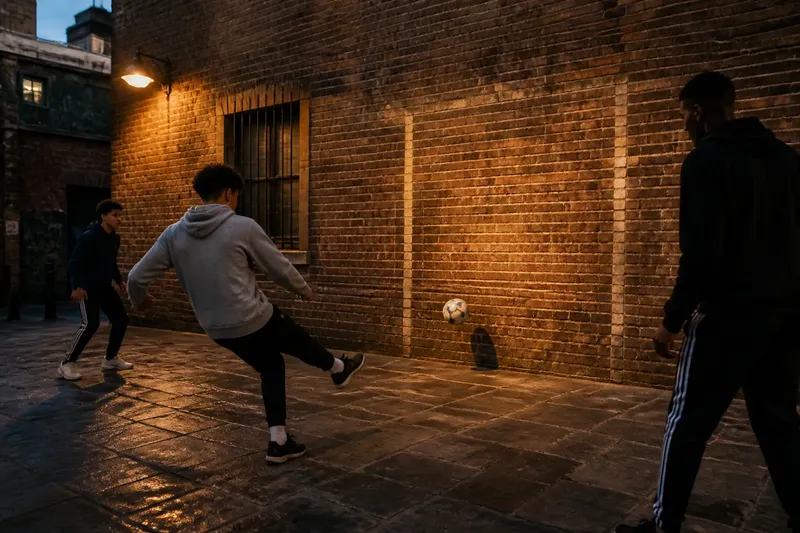
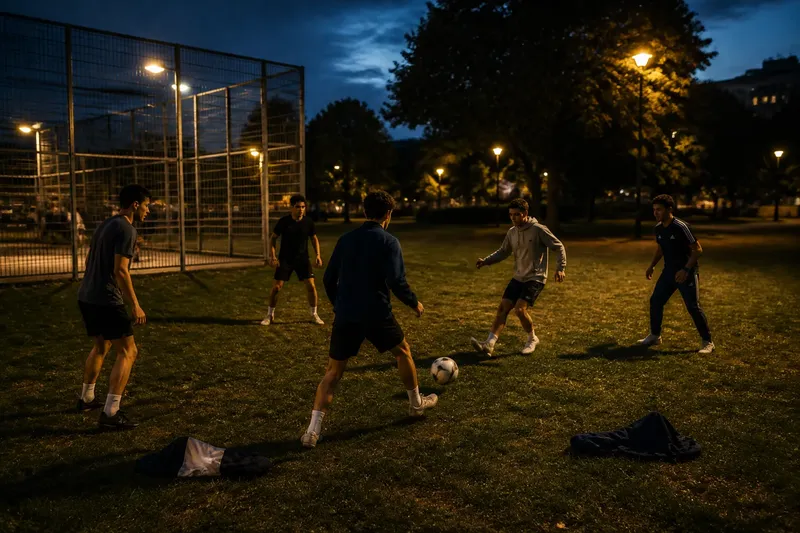
A First Visit to a Neighbourhood Football Game
A first visit to a neighbourhood football game feels less awkward when you can read the local rhythm, ask to join at the right moment, and follow its signals.
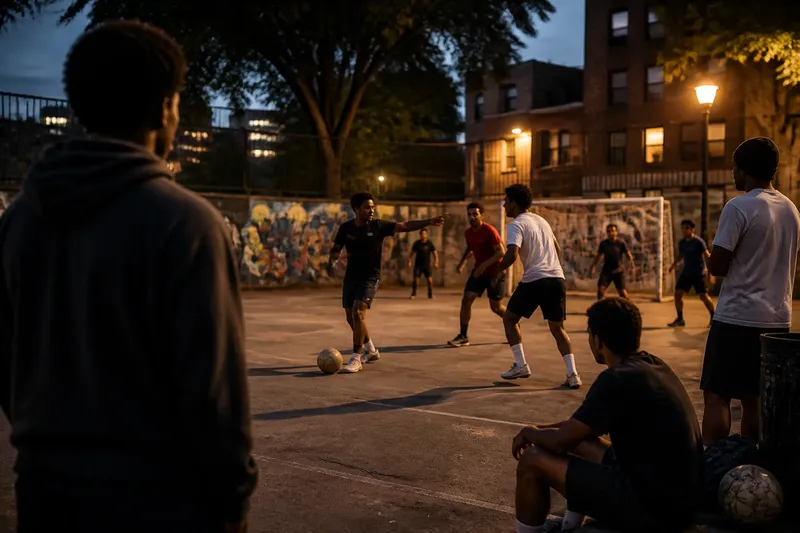
You stop at the edge of a neighborhood game just as a player calls for the ball and another turns to make a run. At a first visit to a neighborhood football game, watching how players communicate can help you understand its local rhythm before you decide whether to join.
Street and park football often runs without a referee, fixed teams, or a formal start time. Its traditions emerge through repeated gestures: who gets the next turn, how players settle a disagreement, and what counts as a fair restart. Focus on those patterns rather than trying to impose rules from another kind of match.
Read the local rhythm before you approach
Watch for a few exchanges and notice who is playing, who is waiting, and how the group responds when someone arrives. In some games, teams rotate after a goal; in others, players stay on until they choose to leave. A newcomer may be welcomed immediately, or the group may have a settled arrangement for that session.
Pay attention to gestures as well as words. A player pointing to a side, offering a hand, or passing you the ball may be signaling an invitation. A quick glance or a smile is less clear, so avoid treating it as a request to enter the match.
Take a moment to learn the game’s pace. Players may keep moving through a brief pause or stop to sort out who has the next turn. Joining at a natural break makes it easier to hear the group and follow what happens next.
Watch for a repeated pattern before deciding what a gesture means.
Ask to join without taking over
Wait until play pauses, then ask a nearby player a direct question such as, “Is there room for another?” If the answer is yes, ask which side to join and whether there is a local rule you need to know. Keep it brief; the players can explain more as the game unfolds.
If the group is full or the answer is unclear, accept that without pressing. You can keep watching from a suitable spot or move on. A game in a public place may feel open, but players still decide how their match is organized.
Once you are playing, begin with the group’s pace. Make a simple pass, pay attention to where teammates are moving, and follow the rotation they use. Avoid calling new rules or changing teams unless the players ask you to help organize.
Local traditions show up in small decisions
Informal football has no single script. Players may settle a close call with a quick replay, let the person who was fouled take the ball, or agree that the goal counts and move on. These choices reflect the group’s habits, not necessarily a formal rulebook.
Notice how players handle a disagreement: do they talk briefly, defer to the person closest to the play, or restart without further discussion? Follow the decision they reach and keep your tone calm. If you are unsure what was agreed, ask at the next pause rather than arguing while the ball is in motion.
Local character can also come from the people who return regularly, the names they give teams, or the way a familiar player welcomes someone new. Let those customs reveal themselves. Asking about a team name or how the group got started can be a friendly conversation once play has ended.
Common questions about joining a neighborhood game?
How can I tell if the game is open to newcomers?
Look for a waiting rotation, players inviting others in, or an open place after someone leaves. If the teams appear settled, ask during a pause rather than stepping onto a side uninvited.
What should I ask before playing?
Ask which team to join and how players rotate or restart after a goal. If you have seen a boundary or call handled in a particular way, ask about that specific situation instead of requesting a full rulebook.
What if I do not know the local style of play?
Say so briefly and follow the group’s pace. Start with straightforward passes, watch how others respond to close calls, and ask for clarification when play pauses.
Can I watch without joining?
Yes, if you remain outside the active play and do not crowd the players. If someone asks you to move or the group’s activity shifts toward your spot, step aside or choose another place.
Use a few clear signals to choose your next move
- If players are waiting in a visible rotation, ask who is next; if the order is already set, wait for your turn or keep watching.
- If a player points toward a team and makes room, join that side; if no one invites you, ask during a pause or stay out of play.
- If players repeat the same restart after a goal, follow that pattern; if their responses differ, ask what they want at the next break.
- If a close call leads to a quick agreement, accept the decision and continue; if the group is still discussing it, wait rather than restarting.
- If a player offers you the ball and makes eye contact, respond with a simple pass; if the signal is unclear, leave the ball for the players.
- If someone says the teams are full, thank them and watch or move along; if a place opens later, ask again only when play pauses.
Imagine you arrive while two teams are playing and one person is waiting beside them. You watch as that person joins after a player leaves, then notice the teams switch ends after a goal. At the next pause, you ask whether there is room and which side needs a player; the group points you toward a team and follows its usual switch. The result is clear: you know where to play and what to expect after a goal, without interrupting the match to set new terms.
Leave the game’s customs intact
As a visitor, you do not need to learn every name or story in one session. Listen when players explain a local habit, use the names they offer, and avoid turning a minor disagreement into a contest over official rules. Familiarity grows through repeated visits and respectful attention.
If you leave before the match ends, do so during a pause when you can. If you borrowed a ball or another item, return it to the person who brought it. A short goodbye is enough; players can carry on with the traditions they have built together.
For a first visit to a neighborhood football game, the most useful skill is noticing how the group makes decisions and then acting in step with them. A clear question at the right pause can tell you whether to join, wait, or simply enjoy watching.